Homeowner guide
What to do with garden waste
Garden waste is not one thing. Some can stay on site, some is worth passing on, some is recycled, and two things are regulated. Here is what to do with each, in the order you will meet it.
Last reviewed September 2026
A garden or landscaping project produces several different kinds of waste, and each has its own route. Some of it can stay on site, some is worth giving away, most of the rest is recyclable, and two things, Japanese knotweed and asbestos in older structures, are regulated and need real care.
This guide takes the waste stream by stream, in the order you are likely to meet it, so nothing catches you out halfway through the job. It is written for anyone planning a garden, landscaping, fencing or patio project, whether you are doing it yourself or having it done.
How much waste does a garden project really produce?
More than people expect, and heavier. Clearing an overgrown border, lifting a patio or taking down a fence generates far more than a few garden bags, and a lot of it weighs a surprising amount. A single cubic metre of soil comes in at roughly a tonne to a tonne and a half, so the spoil from one raised bed or a modest patio dig can outweigh everything else on the job put together.
The other thing that catches people out is that the waste is not one material. Light prunings, dense soil, old treated timber, broken slabs and the occasional regulated item all need handling differently, and mixing them together makes every one of them harder and more expensive to deal with. Deciding where each stream goes before you start, rather than facing a mixed heap in the driveway at the end, is what keeps a project moving. The rest of this guide takes those streams one at a time.
Soil and turf
Can I reuse the soil and turf I dig out?
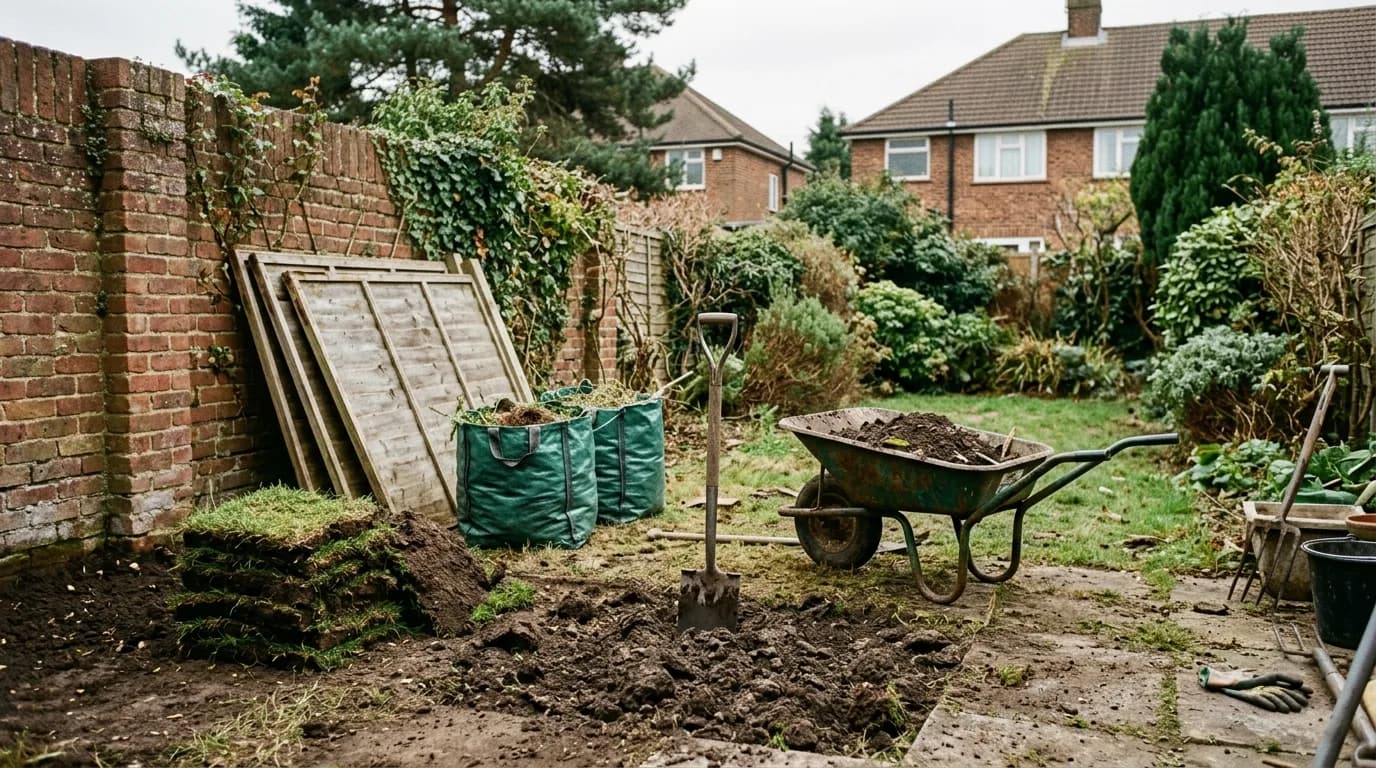
Start here, because soil and turf are the heaviest and most expensive things to move, so anything you can keep is a real saving of effort. Clean topsoil is genuinely useful: it levels low spots, tops up raised beds and borders, and backfills around new foundations or posts. Turf that is lifted in good condition can be relaid elsewhere, or stacked grass-side down in a quiet corner where it rots down into loam over a season or two.
What is left, the excess, the subsoil and clay that is no use to you, or anything you simply have nowhere to put, is what needs removing. The single most useful habit is to keep it separate from rubble and general waste from the start. A clean load of soil is far easier and cheaper to recycle or take away than the same soil mixed with broken slabs and packaging.
Keep the weight in mind for later. Because soil is so dense, it reaches the weight limit of a skip or a car boot long before it looks full, which is why it catches so many people out at the removal stage.
The regulated one
How do I know if I have Japanese knotweed, and what must I do?
This is the one plant that changes what you are allowed to do with your soil, so it is worth knowing on sight. In summer it grows fast into tall, bamboo-like canes, often with purple speckling, carrying bright green leaves shaped like a shovel or a heart that come off the stem in a distinct zigzag. Late in the season it throws out sprays of small creamy-white flowers, and in winter the canes die back to brittle brown stalks. If you are not certain, get it identified before you move any soil, because the roots spread underground and a small fragment is enough to start a new plant.
If you do have it, soil or plant material contaminated with knotweed may be classed as controlled waste, and it must not go in your green bin, your household bin, or a compost heap. If you cannot deal with it on site, it has to go to a landfill or incineration site that holds the correct permit, moved by a registered waste carrier, as set out in GOV.UK guidance on preventing knotweed from spreading.
On the law, having knotweed on your land is not itself an offence, and you are not forced to remove it. What you must not do is cause it to spread into the wild, which is an offence under section 14 of the Wildlife and Countryside Act 1981. Moving contaminated soil off site carelessly, or letting cuttings escape, is exactly how that happens. Between the disposal rules and how readily it regrows, most people treat knotweed as a specialist job rather than something to tackle alongside the ordinary garden clearance.
Green waste
What do I do with grass, prunings and hedge cuttings?
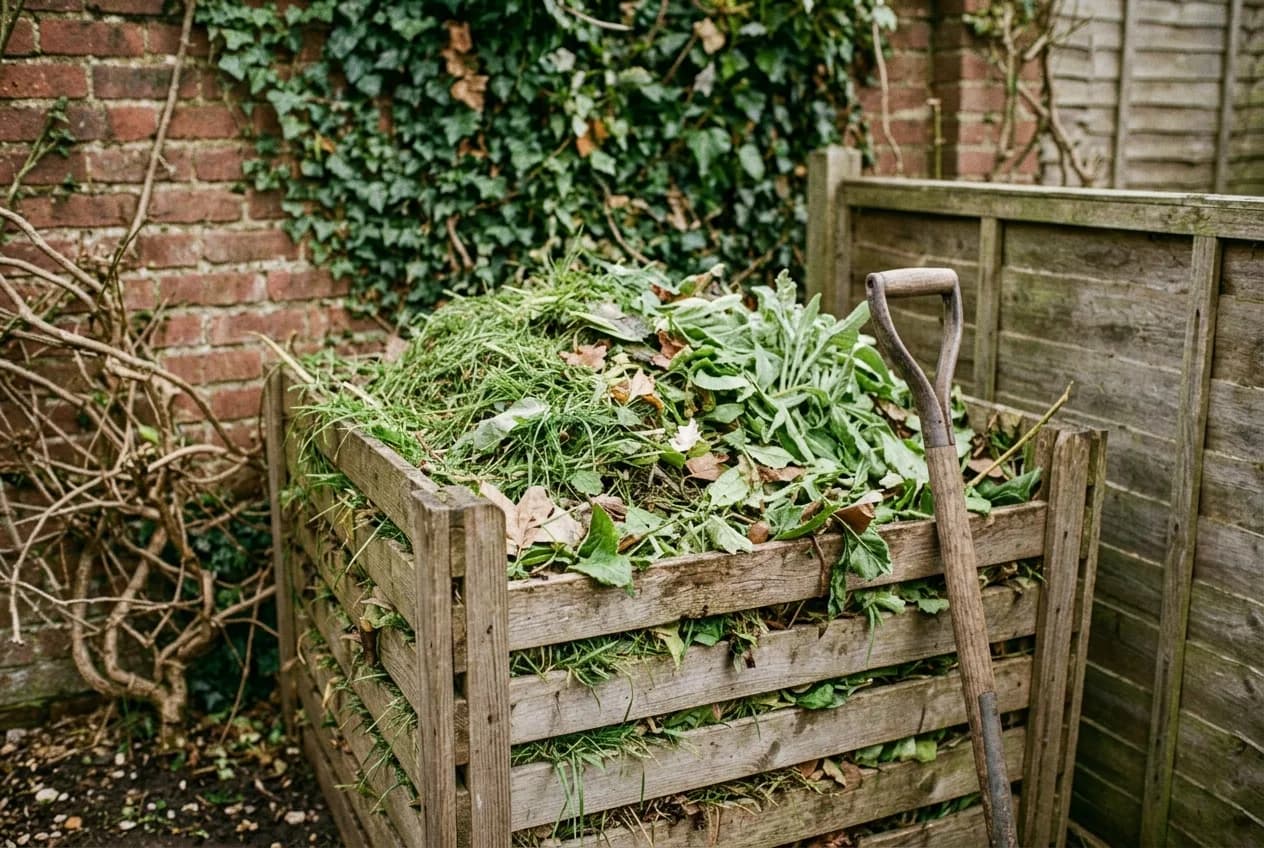
The soft, green end of the pile is the easiest to deal with, and often the greenest option is to keep it. Grass clippings, leaves, spent bedding plants and soft prunings break down well in a home compost heap or bin, and turn back into something useful for the garden. A few things are better kept out of the heap: the roots of perennial weeds, anything showing disease, and woody material, which is slow to rot and better handled another way.
For a bigger clearance than a compost heap can swallow, most councils run a garden waste collection you can put the rest out for. Woody waste and branches that are too big for a bin can go to a household waste recycling centre, and the Recycle Now locator, run by the charity WRAP, will point you to the nearest one that takes it. If you have a lot of branches and access to a chipper, or a tree surgeon already on the job, chipping it into mulch keeps it on site and out of the waste stream entirely.
The cost question
Do I have to pay to get rid of garden waste?
Often, yes, and this is worth checking before you assume it is free. Garden waste collection is not a service every council has to provide, so it varies widely. GOV.UK notes there may be a fee for it, and in practice many councils run it as a paid annual subscription with a wheelie bin or sacks, while some include a limited amount and others do not collect it at all.
The recycling centre is the usual free route for household quantities brought by car, but it comes with its own conditions that catch people out. Many centres limit how much soil, rubble or bagged waste you can bring, ask you to book a slot in advance, or require a permit if you turn up with a van or a trailer rather than a car. It is worth a two-minute check of your own centre before you load up. Note that the GOV.UK collection tool covers England and Wales, and Scotland and Northern Ireland arrange their collections separately.
Still useful
What about old furniture, tools and pots?
Before anything gets thrown out, separate what still has life in it. Garden furniture, tools, planters and pots in usable condition are easy to move on, and the right route mostly depends on whether you want a little money for them or simply want them gone quickly.
- Sell it
- It is easy to underestimate how much of a garden clear-out is worth something to someone. Online, a local listing usually sells fastest because the buyer collects: Facebook Marketplace and Nextdoor reach people nearby, while Gumtree and eBay cast a wider net. In person, a car boot sale, a garage or yard sale, or a table at a local sale shift smaller bits and pieces quickly. And larger or more characterful items, cast-iron furniture, stone planters, reclaimed timber or old tools, can be worth taking to a local auction house, a second-hand dealer or an architectural salvage yard, where they often fetch more than you would expect.
- Give it away free
- To clear usable items quickly without selling, Freecycle and Freegle rehome things locally, often within a day, and the free-listing sections of Facebook Marketplace and Nextdoor do much the same. Trash Nothing pulls several of these local groups together in one place.
- Donate it
- The British Heart Foundation collects furniture and electrical items free of charge, as long as they are in saleable condition, any electricals work, and upholstered items still carry their fire-safety label. Local furniture reuse charities, and the Reuse Network that lists them, take similar items.
- Recycle it
- What is genuinely finished is recycled by material. Metal frames and tools go to a scrap metal recycler, and terracotta or plastic pots, which are often not accepted in kerbside recycling, go to the recycling centre or a garden-centre take-back scheme. The Recycle Now locator finds the nearest option.
Safety first
I am taking out a shed, fence or decking. Is any of it dangerous?
A shed, deck, greenhouse or run of old fencing coming down is really construction waste rather than garden waste, and two materials in older structures deserve genuine care rather than a quick skip run.
The first is asbestos. It was used in cement panels, corrugated roofing sheets and some old shed and garage cladding right up until it was banned in 1999, so anything built or re-clad before 2000 could contain it. The safe approach, following HSE advice, is not to break, drill, cut or sand anything you suspect. Material that is in good condition is usually safest left intact, and if it genuinely has to come out you should keep it damp and unbroken, get it assessed, and deal with it as hazardous waste through your council rather than the ordinary tip. Do not try to remove it yourself if you have had no training for the work. This is a real safety point, not a box-ticking one, and it is worth pausing over before you put a bar through an old panel.
The second is old creosote-treated timber, the kind of fence panel, post or railway sleeper with a dark, oily surface and a strong tarry smell. Creosote has not been sold for amateur use since 2003 and is now restricted to professional treatment. The rule that matters at home is not to burn it: only untreated wood may be burned under the GOV.UK D7 waste exemption, so treated or painted timber goes to a recycling centre or a licensed carrier, never on a bonfire.
Hard landscaping
What do I do with broken paving, hardcore and rubble?
Broken slabs, hardcore and rubble are heavy going, but they are among the most recyclable things a garden produces. Clean, sorted hardcore is crushed and reused as aggregate, so the single best thing you can do is keep it separate from soil and general waste. A clean load recycles more easily and is usually cheaper to move than a mixed one. Recycling centres and local aggregate recyclers take it, and the Recycle Now locator will find the nearest option.
This is also the waste most likely to run into a weight limit, whether that is the boot of a car or the tonnage a skip is rated for, so it is worth planning for its weight specifically rather than lumping it in with everything else.
Rules vary by area
Council garden waste schemes, what a recycling centre will accept, and what a skip provider will take all vary by area. Some centres cap how much soil or rubble you can bring, ask you to book, or need a permit for vans and trailers.
Treat the examples here as the general picture, and check your own local council and recycling centre for the rules where you live. The garden waste collection tool covers England and Wales, and Scotland and Northern Ireland run their collections separately.
When is a skip the right answer, and when is it not?
Once the reusable soil, the compostable green waste, the donations and the sorted recyclables are accounted for, what is left is usually a mixed residue that needs taking away. A skip is one option among several. It earns its place on a bigger clearance where you can load it yourself over a few days and you have somewhere to put it. For smaller or well-sorted amounts, a few trips to the recycling centre may be simpler, and if you cannot load a skip or have nowhere to stand one, a licensed waste carrier or a man-and-van service does the lifting for you.
The one thing to get right, whichever you choose, is weight. Soil, turf and rubble are dense enough that a smaller skip filled with them can reach its limit long before it looks full, which is worth reading up on in our guide to skip hire for garden waste. And if a skip needs to sit on a public road rather than your own driveway, you will need a permit from the council first.
Before you start
Garden clearance checklist
- Separate what can stay on site, clean topsoil for levelling and soft green waste for composting, from what has to leave.
- Learn to spot Japanese knotweed, and if you have it, keep contaminated soil out of bins and compost and treat it as a specialist job.
- Check whether your council charges for garden waste collection, and whether your recycling centre limits soil, rubble or vans.
- Set aside usable furniture, tools and pots to sell or donate before recycling them.
- Treat sheds, fencing and roofing from before 2000 as possible asbestos: do not break it up, and get suspect material assessed.
- Never burn treated, painted or creosote-soaked timber at home.
- Keep hardcore and rubble clean and separate so it can be recycled, and plan for how heavy it is.
- For the residue, decide early between recycling-centre runs, a licensed carrier or a skip, and check whether a skip needs a road permit.
Where this comes from
Sources
- GOV.UK: prevent Japanese knotweed from spreading · checked September 2026
- Wildlife and Countryside Act 1981, section 14 (legislation.gov.uk) · checked September 2026
- HSE: asbestos FAQs · checked September 2026
- GOV.UK: garden waste disposal (find your council) · checked September 2026
- GOV.UK: D7 waste exemption, burning waste in the open · checked September 2026
- Recycle Now recycling locator (WRAP) · checked September 2026
- British Heart Foundation: book a furniture collection · checked September 2026
- Freecycle · checked September 2026
- Freegle · checked September 2026
- GOV.UK: apply for a skip permit · checked September 2026
Common questions
Frequently asked
Can I put soil in my garden waste bin?
No. Council garden waste collections are for green waste like grass, leaves and prunings, not soil, turf or rubble. Reuse clean topsoil on site where you can, and take the rest to a recycling centre or have it removed separately. Check your own council for exactly what its collection accepts.
Is garden waste collection free?
Often not. Garden waste collection is not a service every council has to provide, so many run it as a paid annual subscription and some do not offer it at all. The recycling centre is usually free for household amounts brought by car, though many limit soil and rubble or need a permit for vans. Check your own council and centre before you assume.
Can I burn old fence panels and decking?
Not if they are treated or painted. Only untreated wood can be burned under the GOV.UK waste exemption, and old creosote-treated timber and painted wood are excluded. Take treated timber to a household waste recycling centre or hand it to a licensed carrier instead.
Could my old shed contain asbestos?
It is possible if the structure dates from before 2000, particularly cement panels and corrugated roofing sheets. Do not break, drill or sand anything you suspect. Keep it intact, get it assessed, and treat it as hazardous waste through your council. Do not attempt to remove it yourself unless you have been trained for the work.